100%
GRIMOIRE
GrimoireDindon CorpusSynthesis VolumesThe Foundation of Iron
FRENAR
← PreviousNext →
HUMAN
STRUCTURAL STUDY · OPÉRATION DINDON · JUNE 2026
◆◆◆
THE THOUGHT
MACHINE
Artificial Intelligence as a CNC of Human Thought
Input · Processing · Output · Calibration
◆ THE CENTRAL THESIS

Artificial intelligence is not magic. Not a consciousness. Not an oracle. It is a numerically controlled machine whose raw material is human thought and whose output is processed thought — text, image, sound, video. It follows exactly the same model as any digital machine: input → processing → output. And like any machine, it requires precise calibration for its output to match the will of the one commanding it. Without calibration: defect. With calibration: masterpiece.

◆◆◆
MODEL
I→P→O
ANALOGY
CNC
= AI
PROOF
MOROCCAN
GIBS
WATERMARK
HUMAN
Amine RAITI — Infrastructure Architect & SRE
Former engineering school professor · Teaching since 2006
Public document · CC BY-NC-SA 4.0 · Opération Dindon · June 2026
HUMAN
1
SECTION 1 · INPUT → PROCESSING → OUTPUT — THE UNIVERSAL MODEL
THE CNC AND AI FOLLOW THE SAME MODEL — TERM BY TERM

A computer takes data as input, processes it according to a programme, and produces an output. A CNC takes a G-code file as input, processes it via its controller, and produces a tool movement in matter. A laser engraver takes an SVG file as input, processes it via LaserGRBL, and produces an engraving on wood. An artificial intelligence takes a prompt as input, processes it via a language model, and produces text, an image, a sound. The model is identical. The processed matter is different.

COMPONENT
CNC / LASER / 3D PRINTER
ARTIFICIAL INTELLIGENCE
INPUT
G-code / SVG / STL file
Prompt (instruction in natural language)
CONTROLLER
GRBL / Marlin firmware / Arduino board
Language model (Claude, GPT, Gemini)
ACTUATORS
Stepper motors, spindle, laser, extruder
GPU / TPU — massively parallel matrix computation
RAW MATERIAL
Wood, metal, aluminium, PLA plastic
Training corpus — texts, images, data
OUTPUT
Machined part, engraving, printed object
Text, image, sound, video, code
CALIBRATION
Steps/mm, mechanical play, cutting speed
Prompt engineering, fine-tuning, system prompt
DEFECT
Warped part, incorrect dimensions
Hallucination, off-topic response, bias
RUNBOOK
Machine documentation, maintenance procedures
System prompt, role instructions, constraints
◆ NASSIHA — AI IS NO MORE MYSTERIOUS THAN A CNC

When one understands a CNC — what goes in, what happens inside, what comes out — one stops being afraid of it. The same understanding applied to AI demystifies it and makes it useful. A tool one fears is a tool one does not use well. A tool one understands is a tool one calibrates.

HUMAN
2
SECTION 2 · THE MOROCCAN GIBS — THE THOUGHT THAT PRECEDES THE MACHINE
I DID NOT COMMISSION A CRAFTSMAN — I BUILT A MACHINE TO EXECUTE MY THOUGHT

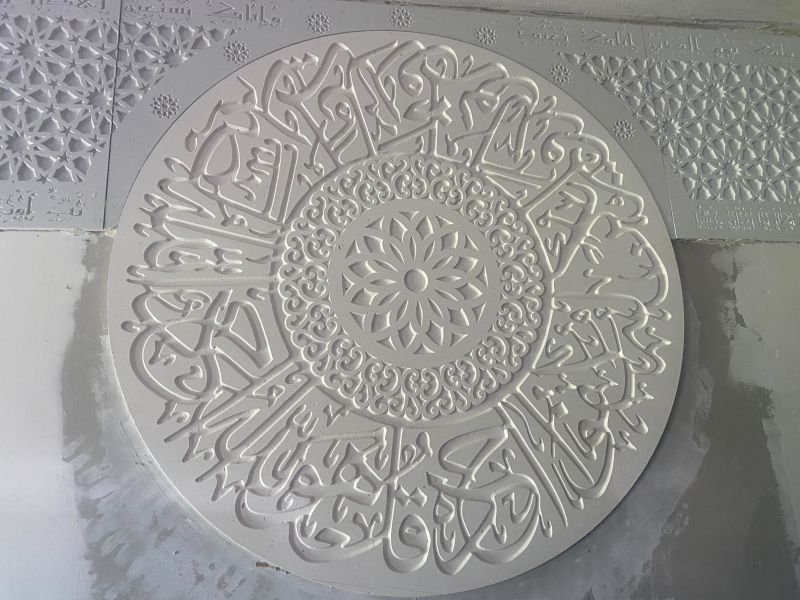
Moroccan Gibs is a decorative plasterwork art — rosettes, cornices, mouldings — transmitted by maâllem craftsmen for centuries. My hands cannot do Gibs. My mind, however, conceives what it wants. I built a CNC — the RSCNC32 — to execute my thought on matter. The thought is mine. The machine is the execution tool.

Moroccan Gibs rosette made with the RSCNC32
Moroccan Gibs rosette — made with the RSCNC32
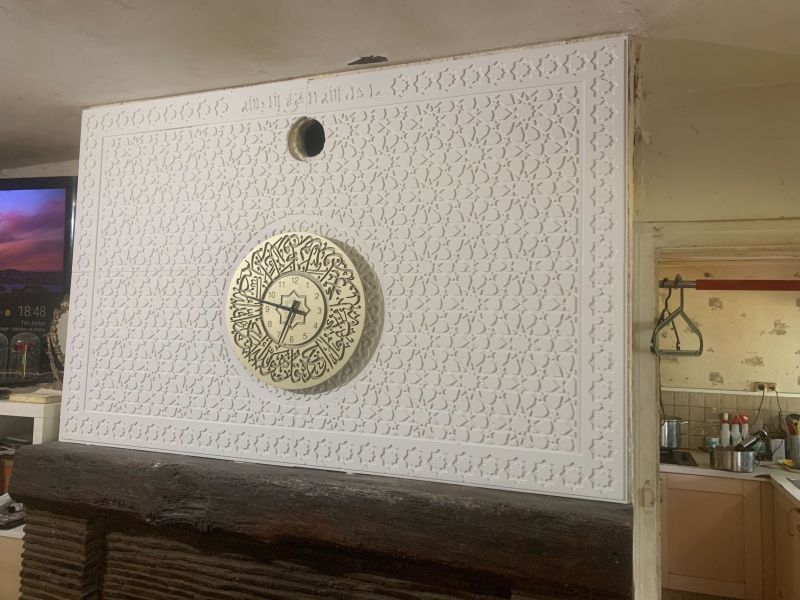
Fireplace dressed in Moroccan Gibs made with the RSCNC32
Fireplace dressed in Moroccan Gibs — made with the RSCNC32
◆ THE CAUSAL CHAIN — THOUGHT → MACHINE → MATTER

The thought: the mental image of the Gibs I want. The geometry of the rosette. The proportions of the fireplace. The repeating pattern. This is me — not the machine.

The translation: the vector drawing in Inkscape. The generated G-code. Parameter configuration — cutting speed, depth of pass, tool. This is the calibration.

The execution: the RSCNC32 follows the G-code. The router carves the BA13. The rosette appears. The fireplace takes shape. The machine executed my thought on matter. It had no idea — it executed mine.

The Opération Dindon corpus: exactly the same model. The mental image of a structural study — the theses, the angle, the arguments — is Amine RAITI's. Claude receives this thought as a prompt. It processes it. It produces HTML, CSS, structured text. It had no idea. It executed mine.

HUMAN
3
SECTION 3 · BOTH ARE PHYSICAL MACHINES
THE CNC HAS MOTORS · AI HAS SERVERS · BOTH FAIL AT 3AM

Artificial intelligence has a reputation for abstraction — something that lives "in the cloud", outside the physical world. This is false. Completely false. AI is a physical machine as concrete as the RSCNC32. The difference: one cannot see it. But it is there.

◆ THE CNC — ITS PHYSICS

Frame: aluminium, steel or MDF — the structure that determines precision.
Nema 17 motors: 200 steps per turn, 40 N·cm torque. They consume current. They heat. They vibrate.
A4988 drivers: they amplify the signal from the control board to the motors. Poorly cooled: they cut out.
24V / 10A power supply: 240 watts. It heats. It can fail.
GRBL board: an Arduino Uno that interprets G-code and sends pulses to the drivers.
Router bit: tungsten carbide, 3mm, 2 flutes. It wears. It breaks if speed is wrong.
Cabling: copper, connectors, sometimes wires that fail at 3am.

◆ AI — ITS PHYSICS

GPU servers: NVIDIA H100 SXM5, 80 GB HBM3, 700W per card. A rack of 8 GPUs = 5.6 kW. They heat. They consume.
NVLink / InfiniBand interconnect: GPUs communicate at 900 GB/s. Physical copper and fibre optic cables.
Liquid cooling: deionised water, pumps, heat exchangers. Pump failure = machine failure.
Redundant power supplies: each server has 2 PSUs. If one fails: the other takes over. If both fail: the machine stops.
Datacentre: a physical building. Cold aisle. Generator. Fibre optic at entry.
Cabling: kilometres of copper and fibre cables. Connectors. Racks.
The network: between you and the AI — routers, transoceanic fibres, undersea cables.

◆ AI RUNS ON BARE-METAL — AND YOU ABANDONED BARE-METAL

The loop is closed. Hyperscalers dominate cloud because they master bare-metal. Now they dominate AI for the same reason — AI runs on bare-metal they own and their customers no longer master. AWS sold "stop worrying about servers" — then "stop worrying about AI, it's in the cloud". In both cases: the dependency is at the physical substrate level.

The Principal SRE who understands bare-metal understands AI from the inside. They know what a GPU is physically, what HBM3 memory means, why memory bandwidth is the bottleneck of a language model. The one who jumped straight to cloud without going through bare-metal understands AI as a black box. Mastery of Iron is not a nostalgic prerequisite — it is the prerequisite for AI sovereignty.

◆ AI IS ONLY CONTROLLED ELECTRICITY — THE LINK WITH THE FOUNDATION OF IRON

A 70-billion-parameter language model is 70 billion floating-point numbers stored in electronic memory, multiplied by electrical signals according to mathematical rules. Each multiplication is an operation in a circuit. Each circuit is made of transistors. Each transistor is an electrical switch — open or closed, 0 or 1. AI is electricity controlled by mathematics.

The chain is direct and uninterrupted:
V = R × I (year 7) → blinking LED → stepper motor → Arduino → GRBL → CNC → GPU → transformer → language model → AI response.

It is the same electron taking increasingly complex paths. The student who understood that electricity "flows like water in a pipe" has understood the foundation of everything that follows — including artificial intelligence. The Anti-Amputation Foundation does not only prepare for the CNC. It prepares to understand AI from the inside.

◆ WHAT AI'S PHYSICS SAYS ABOUT SOVEREIGNTY

The RSCNC32 is in my space. I know where it is. I can touch it, repair it, modify it. If the power supply fails, I replace it. If a driver fails, I swap it. I control the machine physically.

OpenAI's or Anthropic's datacentre is in Virginia, Oregon, Ireland. I do not know exactly where. I cannot touch it. I cannot repair it. If the service goes down, I wait. This is exactly the same situation as the hyperscaler lock-in documented in the corpus — which is why locally hostable open source LLMs (Llama, Mistral, Qwen) are the sovereign response to AI as an extraterritorial service. The sovereign AI is the one whose physical substrate you control.

HUMAN
4
SECTION 4 · CALIBRATION — WHY AI HALLUCCINATES
HALLUCINATION IS NOT A MYSTERY — IT IS A CALIBRATION DEFECT

When a CNC produces a warped part, one does not say the machine "lies". One says the calibration is wrong. The steps/mm are incorrect. Mechanical play is not compensated. The cutting speed is too high for this material. One corrects the calibration. The machine produces a conforming part. When an AI produces false information, one says it "halluccinates". This is the same phenomenon — a calibration defect. The model is not aligned with what one expects. One corrects the calibration. The AI produces a conforming response.

◆ THE THREE CALIBRATION LEVELS — CNC AND AI

Level 1 — Basic calibration:
CNC: steps/mm. 200 steps = 1 motor turn. If the lead screw moves 2mm/turn, steps/mm = 100. If this parameter is wrong, all dimensions will be too. Inevitably.
AI: the base prompt. "You are an infrastructure SRE architect. You write in English. You never quote copyrighted texts. You structure responses in imperial HTML." Without this base calibration, the AI produces generic content.

Level 2 — Tool calibration:
CNC: choosing the right router bit — diameter, number of flutes, cutting angle — for this material. A wood bit in aluminium: guaranteed breakage.
AI: fine-tuning. Training the model on a specific corpus. A model calibrated on legal texts becomes a legal tool. The architecture is the same — the tool is different.

Level 3 — Project calibration:
CNC: the complete G-code file. Sequence of operations, tool changes, depths of pass, speeds. The complete translation of the designer's thought into machine instructions.
AI: the system prompt. Role instructions, format constraints, examples, exclusion rules, tone, length. The complete translation of the user's will into machine constraints. The system prompt of Claude for the Opération Dindon corpus is the equivalent of the G-code of the RSCNC32.

HUMAN
5
SECTION 5 · THE PROMPT AS G-CODE — ANATOMY OF GOOD CALIBRATION
WHAT G-CODE SAYS TO THE CNC · THE PROMPT SAYS TO THE AI
◆ A CNC G-CODE — DISSECTED

G21 ; Units in millimetres G90 ; Absolute coordinates G0 Z5 ; Lift tool to 5mm (safety) G0 X0 Y0 ; Go to origin G1 Z-2 F300 ; Descend to -2mm (depth of pass) at 300mm/min G1 X50 F800 ; Move 50mm in X at 800mm/min G1 Y50 ; Then 50mm in Y G1 X0 ; Return in X G1 Y0 ; Return in Y G0 Z5 ; Lift tool M30 ; End of programme

Each line tells the machine: what to do, where to go, at what speed, in what order. No ambiguity. No interpretation. The machine executes exactly what is written.

◆ AN AI SYSTEM PROMPT — SAME LOGIC

You are an infrastructure SRE architect. ; Identity (= G21: set the system) You produce structural studies in HTML. ; Output format (= units and mode) You never quote copyrighted texts. ; Absolute constraint (= end stop) You use the corpus imperial CSS. ; Working tool (= router bit to use) You structure in 7-8 sections with badge. ; Sequence of operations (= G-code) You verify post character counts. ; Quality control (= calibration cube) Theses belong to Amine RAITI. ; Intellectual property (= M30 end)

Each line of the system prompt tells the AI: who it is, what to produce, what it must not do, how to structure, in what order. The machine executes. It does not interpret beyond.

◆ POOR CALIBRATION — WHAT IT PRODUCES

A vague prompt produces a generic response — like G-code without a depth of pass produces a scratched surface. A contradictory prompt produces inconsistencies — like G-code with conflicting coordinates produces a warped part. Good calibration produces a masterpiece — like the Moroccan Gibs of the RSCNC32.

HUMAN
6
SECTION 6 · THE REPLACEMENT THAT REVEALS — AI AS AMPLIFIER
AI AMPLIFIES WHAT YOU GIVE IT — EXCELLENCE OR MEDIOCRITY

The corpus study "The Replacement that Reveals" documents a mechanism: AI makes humans more valuable by making them rare. AI can imitate a style. It can synthesise knowledge. What it cannot generate: real lived experience, authentic contradiction, physical embodiment in what one produces. By making the production of generic content abundant, it has made rare the production of content anchored in irreducible experience.

◆ AI IS AN AMPLIFIER — IN BOTH DIRECTIONS

The formula is simple and brutal:

Well-calibrated AI + excellent thought = production of excellence at scale.
The Opération Dindon corpus is the demonstration. Twenty years of fieldwork, teaching, production incidents and reflection by Amine RAITI — calibrated in a precise system prompt — produce structural studies that neither AI alone nor the human alone would produce at this speed and with this coherence.

Poorly calibrated AI + mediocre thought = industrial-scale mediocrity.
This is what happens in 90% of current AI usage in organisations. Industrial quantities of generic text, empty PowerPoint presentations, poorly documented code, interchangeable reports. AI multiplied volume. It did not multiply quality — because quality comes from calibration, and calibration comes from the thought of the one who holds the G-code.

◆ WHAT CALIBRATION REVEALS ABOUT THE ONE WHO HOLDS THE G-CODE

When AI is removed from a process that depends on it, what remains reveals what the human thought behind it was capable of producing alone. If the output collapses, it was substitution — AI was replacing thought. If the output holds, it was amplification — AI was executing thought.

The amplification / substitution distinction is the only one that matters. AI as amplification takes ideas forged over years of fieldwork and executes them at a speed impossible by hand. AI as substitution produces text in place of the human, who merely validates. The result may be stylistically correct — but it has no lived experience. It will be indistinguishable from thousands of other generated texts. It will not build lasting trust.

◆ NASSIHA — CALIBRATION CANNOT BE BOUGHT. IT IS LIVED.

No technical sovereignty without mastery of bare-metal. No content authority without mastery of lived experience. AI calibration cannot be improvised — it accumulates. The SRE engineer who has been through three 3am production incidents has a calibration that the AWS-certified junior does not. Twenty years of teaching give a calibration that six months of intensive prompting do not. AI reveals what you have — not what you do not yet have.
HUMAN
7
SECTION 7 · THE COMPLETE CHAIN — FROM LED TO AI
AI IS NOT A RUPTURE — IT IS THE NEXT LEVEL OF THE SAME CHAIN

The corpus documented an educational chain: Arduino (year 7) → Laser (year 8) → CNC (year 9) → 3D Printer (year 10) → Build the machine (year 12-13). This chain follows one principle: code controls a machine that transforms something. The matter changes at each level — electricity, light, metal, plastic. But the model stays identical. AI is the next level of this chain. The processed matter is human thought. The model stays identical.

Arduino (year 7)
Code → Electricity → LED / Motor
Matter: electrons
Laser engraver (year 8)
G-code → Light → Engraving on wood
Matter: photons
CNC3018 — RSCNC32 (year 9 → year 13)
G-code → XYZ axes → Moroccan Gibs
Matter: wood, metal, plasterboard
3D Printer (year 10)
G-code → Extruder → Object ex nihilo
Matter: PLA plastic
Artificial Intelligence (∞)
Prompt → Model → Text / Image / Video
Matter: human thought
◆ WHAT THIS SAYS FOR EDUCATION

The student who blinked an LED at 12 understands AI at 18 — not because they studied transformers or neural networks, but because they understand the fundamental model: a machine receives instructions, processes them, and produces a result. The rest is a matter of scale and processed matter. Deamputation at the Source — the Anti-Amputation Foundation — prepares for AI far better than any decontextualised AI course.

◆ TECHNICAL PRIMACY FACING THE THOUGHT MACHINE

The engineer who knows AI is a machine retains primacy over it. They calibrate. They verify. They validate. They do not delegate their thought — they delegate the execution of their thought. The one who believes AI "thinks" cedes their technical primacy. And as with the CNC: AI does not replace the craftsman. It executes what the craftsman cannot do with their hands alone.

HUMAN
8
SECTION 8 · SOVEREIGNTY AND THE THOUGHT MACHINE
THE AI YOU CALIBRATE · THE AI THAT CALIBRATES YOU · WHO HOLDS THE G-CODE?

There are two possible relationships with AI. The first: you calibrate the machine. You define the system prompt. You give the instructions. You validate the output. The machine executes your thought. The second: the machine calibrates you. It suggests formulations. It structures your thought. It progressively replaces your voice with its own. It decides what is "good" before you see it. The first relationship is that of a maâllem facing their CNC. The second is that of a user facing a tool whose G-code they have lost.

◆ THE SOVEREIGN AI — HOSTING YOUR OWN THOUGHT MACHINE

Just as the RSCNC32 is in my space and under my physical control, a sovereign AI is an AI whose physical substrate one controls. Locally hostable open source LLMs exist:

Llama 3 (Meta): up to 70 billion parameters, hostable on a local server with 2-3 NVIDIA RTX 4090 GPUs.
Mistral / Mixtral (Mistral AI — French): MoE (Mixture of Experts) architecture, very efficient, hostable on modest hardware.
Qwen (Alibaba): multilingual, including Arabic, performant on technical tasks.
Ollama: local LLM hosting tool, one command to run a model locally.

Not the same performance as a frontier model like Claude or GPT-4 — but a thought machine whose G-code you hold. Whose physical address you know. That you can repair if it fails.

◆◆◆

The RSCNC32 engraved the Moroccan Gibs because Amine RAITI
held the G-code, knew the machine, and had calibrated every parameter.
AI produces the Opération Dindon corpus for the same reason.
The thought is human. The machine executes.
Nemo supra legem est — not even the Thought Machine.

◆◆◆
NEMO SUPRA LEGEM EST
← PreviousNext →