100%
GRIMOIRE
GrimoireDindon CorpusSynthesis VolumesThe Foundation of Iron
FRENAR
HUMAN
STRUCTURAL STUDY · OPERATION DINDON · JUNE 2026 · FOURTH NEWSPEAK
◆◆◆◆◆
THE MYSTICAL MACHINE
How AI Was Made Incomprehensible to Better Be Sold
Anatomy of a Logical Numerical Control System · Fourth Newspeak of Operation Dindon
◆ THE CENTRAL THESIS

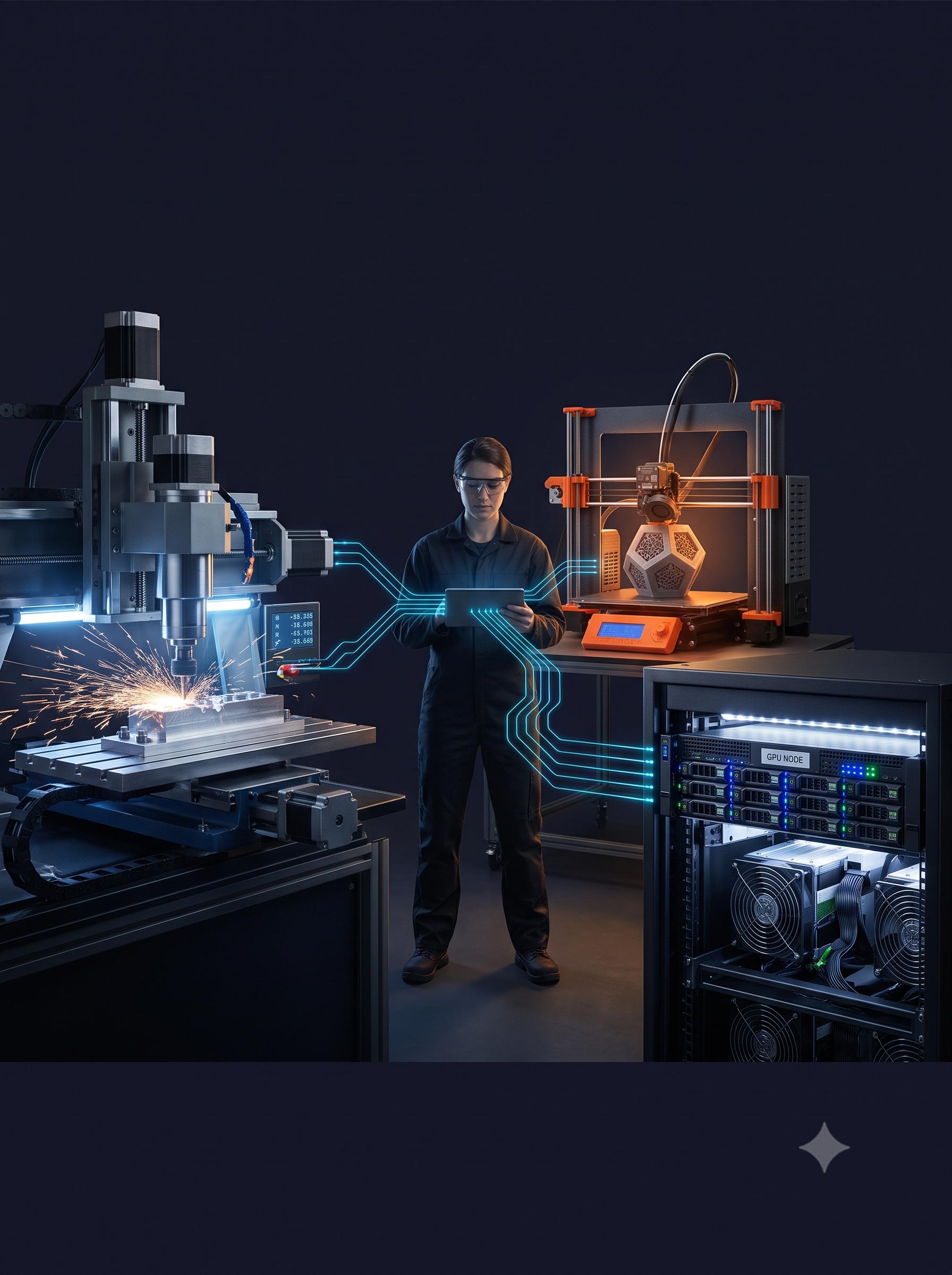
The term "Artificial Intelligence" is a semantic false friend in the same way as "Sovereign Cloud": it sells a property that is not there. A CNC, a 3D printer, a laser engraver and a language model are all controlled electricity transforming an input into an output according to parameters. The only difference is the working layer — physical for the CNC, logical for the LLM. The mystification of the term "Intelligence" is a commercial strategy serving the same interests as "NoOps," "Serverless" and "Sovereign Cloud."

◆◆◆
PAGES
8
NEWSPEAK N°
4
WATERMARK
HUMAN
dominant
GRAPHS
0
The Mystical Machine — CNC · 3D Printer · AI Rack
Amine RAITI — Infrastructure Architect & SRE
Former engineering school professor · Teaching since 2006
Public document · CC BY-NC-SA 4.0 · Operation Dindon · June 2026
HUMAN
1
SECTION 1 · THE FUNCTIONAL COMPARISON — FROM CNC TO LLM
A CNC, A 3D PRINTER, A LASER ENGRAVER AND A LANGUAGE MODEL ARE THE SAME THING — DIFFERENT LAYER
◆ THE COMMON STRUCTURE — INPUT · PROCESSING · OUTPUT

CNC: input = G-code file · processing = firmware + stepper motor controller · output = machined metal part at 0.01mm precision. Electricity moves motors that move a tool that removes material.

3D Printer: input = STL file + slicing parameters · processing = Marlin/Klipper firmware · output = physical object layer by layer. Electricity heats a resistor and moves a nozzle.

Laser engraver: input = vector file + power/speed · processing = GRBL controller · output = engraved or cut material. Electricity excites a laser diode at a precise wavelength.

Inkjet printer: input = raster file · processing = print firmware · output = printed document. Electricity propels 2-picoliter ink droplets at 1200 DPI.

Language model (LLM): input = token sequence · processing = matrix multiplication across billions of parameters on GPUs · output = most probable token sequence. Electricity moves electrons through 3nm transistors performing floating-point additions.

◆ THE LAYER DIFFERENCE — NOT A NATURE DIFFERENCE

In every case: controlled electricity → result according to parameters. The CNC works in the physical layer — produces matter. The LLM works in the logical layer — produces symbols. Not a difference of nature. A difference of output domain.

◆ NETWORK PHYSICS — WHAT THE CNC DOES NOT HAVE AND THE LLM REQUIRES

A CNC has 50cm of copper between controller and motors. A GPU cluster for distributed inference has kilometres of InfiniBand cable at 400 Gb/s, microsecond latency between nodes, and HBM memory bandwidth of 2 TB/s per chip. Bare-metal AI demands mastery of low-level network layers (L1/L2) even more rigorous than classical bare-metal — rehabilitating the infrastructure engineer as indispensable guardian of sovereign AI.

HUMAN
2
SECTION 2 · WHAT THE WORD "INTELLIGENCE" HIDES — A FALSE FRIEND LIKE "SOVEREIGN CLOUD"
McCARTHY 1956 · THE TERM WAS CHOSEN FOR PRESTIGE — NOT FOR PRECISION
◆ THE HISTORY OF THE TERM — DARTMOUTH 1956

In 1956, John McCarthy chose the term "Artificial Intelligence" — not for descriptive precision, but for academic prestige. An LLM does not "understand." It predicts the probability distribution of the next tokens according to weights adjusted during training. Remarkable engineering. Not intelligence in the philosophical sense.

◆ THE STRUCTURAL FALSE FRIEND — SAME MECHANIC AS "SOVEREIGN CLOUD"

The Operation Dindon corpus documented that "Sovereign Cloud" sells a legal sovereignty that does not exist (physical ✓ / legal ✗). "Artificial Intelligence" is the same deception structure: it sells a philosophical intelligence that does not exist (matrix computation ✓ / intelligence ✗). Both use a strong word ("sovereign," "intelligence") to name the property the client desires without it actually being present.

◆ HISTORICAL PERSPECTIVE — THE TAPE RECORDER, THE VCR, TELETEXT

Every generation experienced its own "incomprehensible revolution." In 1965, the reel-to-reel tape recorder recorded and replayed a human voice — considered almost magical by those who did not understand magnetic induction. In 1975, the VCR captured a television broadcast for replay at will — described as incomprehensible by the uninitiated. In 1980, Teletext transmitted text via the television signal — deemed futuristic and world-changing.

None were magic. All were controlled electricity applied to a new domain. Generative AI in 2024 is at its maturity stage what the VCR was in 1975: impressive for its era, already demystified by engineers who understand its low-level layers, destined to become commonplace in five to ten years. Not a reason to deify it now.

RATIO
3
SECTION 3 · MYSTIFICATION AS COMMERCIAL STRATEGY — RAG · CONTEXT CACHE · HERITAGE EXTRACTION
"YOU CANNOT DO THIS YOURSELVES" — THE SAME NEWSPEAK AS SERVERLESS AND NOOPS
◆ MYSTIFICATION AS COMMERCIAL ARGUMENT

OpenAI, Azure OpenAI, AWS Bedrock, Google Vertex AI — identical discourse: AI is too complex, too resource-hungry, too specialised to deploy without a hyperscaler. Permanent subtext: "You cannot do this yourselves." Exactly the Serverless and NoOps discourse — applied to AI. Partially true for some use cases. Deliberately exaggerated for all others.

◆ RAG — HERITAGE MEMORY EXFILTRATION · cf. SaaS Layer 3 · Anatomy of Digital Perdition (16p)

When a company uses Azure OpenAI to index internal documents via RAG, it indexes its intellectual property in proprietary vector databases — Azure AI Search, Amazon Kendra, Pinecone on AWS. Documents theoretically remain with the company. Embeddings reside in the hyperscaler's infrastructure. Invisible exfiltration of heritage memory. Using the hyperscaler's AI to index data means giving them the blueprints of the organisation's own applicative black box.

◆ CONTEXT CACHE AND PROMPT TELEMETRY — REAL-TIME EXTRACTION

Context Caching API features store internal documentation, source code, business procedures sent with each request in the hyperscaler's clusters — under cover of "security telemetry."

The difference from RAG: RAG exfiltrates structured memory (documents). Context cache exfiltrates living memory — real-time prompts, source code sent with each request. The difference between stealing blueprints and installing a camera in the meeting room. Covered by "telemetry" clauses nobody reads — exactly like Terms §14.12.

RATIO
4
SECTION 4 · AI BARE-METAL — OPEN-WEIGHTS vs OPEN-SOURCE · NVIDIA/CUDA · LANGCHAIN
OWNING YOUR AI DOES NOT MEAN PLEDGING ALLEGIANCE TO NVIDIA — THREE SOVEREIGNTIES TO AUDIT
◆ THE CRUCIAL LEGAL DISTINCTION — OPEN-WEIGHTS ≠ OPEN-SOURCE

Llama 3 (Meta) is under a restrictive commercial licence — prohibition on using weights to train a competing model, restrictions beyond 700 million users. Open-Weights, not Open-Source under OSI. Genuinely free licences: Mistral 7B (Apache 2.0) · Falcon 7B/40B (Apache 2.0). A unilateral licence change can block software infrastructure post-deployment — exactly like a cloud Terms modification.

◆ NVIDIA/CUDA — THE NEW UPSTREAM LOCK-IN · cf. The Taiwan Bottleneck (6p)

Replacing OpenAI/Azure API with NVIDIA A100/H100 GPUs solves only one level. NVIDIA owns proprietary locks — CUDA, cuDNN, NCCL — and production depends entirely on TSMC in Taiwan (~90% of advanced chips worldwide). The answer: open abstraction runtimes. ROCm (AMD) · vLLM · Ollama · llama.cpp — run models on heterogeneous hardware. Owning your AI in bare-metal means the parameter file can run on any available silicon.

◆ LANGCHAIN/LLAMAINDEX — AI SOFTWARE LAYER 2 LOCK-IN

Having Mistral on vLLM is insufficient if application code is entangled in LangChain abstractions optimised for cloud ecosystems. LangChain and LlamaIndex are designed to interface natively with hyperscaler APIs. Their wrappers push toward proprietary cloud memory or agent functions. Runtime sovereignty requires standardised interfaces — the OpenAI-compatible API exposed by vLLM — and rejection of opaque orchestration frameworks. Software Layer 2 lock-in applied to AI.

RATIO
5
SECTION 5 · SOVEREIGN AI TCO — VOLUMETRIC BREAK-EVEN AND HIGH-DENSITY PUE
THE FORMULA THE CFO AWAITS — AND THE HIDDEN COSTS THE DATACENTRE ENGINEER KNOWS
◆ THE VOLUMETRIC BREAK-EVEN

Cloud API: billed per token — pure variable OPEX. Bare-metal GPU server: CAPEX + fixed OPEX (electricity, rack, maintenance).

Cloud API cost: N requests × cost_per_token × avg_tokens
Bare-metal cost: GPU_CAPEX / amortisation + fixed_monthly_OPEX

From documented cases: for intensive use (>100,000 requests/day with long contexts), bare-metal becomes profitable in 6 to 18 months. Below this threshold, the cloud API remains competitive. Intellectual honesty requires naming this threshold — not pretending bare-metal always wins.

◆ THE HIDDEN COST — PUE AND HIGH-DENSITY THERMAL LOAD

An AI compute chassis (HGX A100 8 GPUs) consumes 10 to 40 kW per rack. Classical datacentre: sized for 5 to 7 kW per rack. A civil engineering problem that TCO formulas without a datacentre engineer systematically ignore.

PUE factor: for high-density AI compute, PUE 1.5 means 40 kW GPU + 20 kW cooling = 60 kW billed at the floor. Without liquid cooling or hot-aisle containment, operating costs explode.

Complete TCO formula: GPU_CAPEX + cooling_CAPEX + (GPU_kW × PUE × kWh_cost × annual_hours) + maintenance. High-density PUE is what the application engineer forgets and the datacentre engineer cannot ignore.

HUMAN
6
SECTION 6 · THE THREE AI SOVEREIGNTIES — PERFECT SYMMETRY WITH CORPUS LOCK-IN LAYERS
WEIGHTS · RUNTIME · TRAINING DATA — SAME STRUCTURE AS CONTRACTUAL · SOFTWARE · MATERIAL
CORPUS LOCK-IN LAYERS
Layer 1 — Contractual
Terms §14.12 · CLOUD Act · non-cancellable commits

Layer 2 — Software
Artificial complexity · total rewrite

Layer 3 — Material
TSMC ~90% · IME/PSP · Taiwan

cf. Anatomy of Digital Perdition (16p)
THREE AI SOVEREIGNTIES
Sovereignty 1 — Weights
Apache 2.0 vs restrictive Open-Weights · Licence audit

Sovereignty 2 — Runtime
vLLM/ROCm/Ollama vs CUDA · Standard API vs LangChain

Sovereignty 3 — Training data
Documented vs opaque models · Training traceability

Perfect symmetry — same capture structure
◆ WHAT THE SYMMETRY SAYS

Weights Sovereignty = Contractual Layer: do I legally own the model without future unilateral restriction? Runtime Sovereignty = Software Layer: do I execute on my infrastructure with an open framework without artificial complexity? Training Data Sovereignty = Material Layer: do I know the foundations of what I use?

Proprietary model · opaque runtime · CUDA locked to TSMC chips · unknown training data = total AI captivity. Same structure as cloud captivity documented in 64 corpus studies.

HUMAN
7
SECTION 7 · THE FOURTH NEWSPEAK — CORPUS LINK · CLOSING
THE OPERATION DINDON CORPUS DOCUMENTED FOUR NEWSPEAKS — AI IS THE FOURTH AND MOST POWERFUL
1
"Sovereign Cloud" — sells a legal sovereignty that does not exist. Physical ✓ / CLOUD Act ✗. cf. The Cloud-Washing (7p)
2
"Serverless" — sells the absence of servers. There are servers — at the hyperscaler. cf. The Newspeak That Costs Dear (12p)
3
"NoOps" — sells the elimination of operations. They migrated to the hyperscaler. cf. NoOps — Autopsy (6p)
4
"Artificial Intelligence" — sells a philosophical intelligence that does not exist. Matrix computation ✓ / Intelligence ✗. The most powerful: operates on the representation engineers themselves have of their own tool.
◆◆◆

AI is controlled electricity.
The GPU is hardware.
The model is a parameter file.
Inference is matrix computation.
Everything else is marketing.

Amine RAITI · Operation Dindon · 2026

◆◆◆
NEMO SUPRA LEGEM EST