100%
GRIMOIRE
GrimoireDindon CorpusSynthesis VolumesThe Foundation of Iron
FRENAR
← PreviousNext →
HUMAN
STRUCTURAL STUDY · OPÉRATION DINDON · JUNE 2026
◆◆◆
THE MENTOR
AND THE METAL
M3allem · Met3allem · SRE
◆ CONTEXT OF THE STUDY

The Zellij of Fès, the Gibs of Meknès, the leather craft of Marrakech — these arts have survived only because the M3allem/Met3allem process was never broken. This process is the same one that produced the best infrastructure engineers this corpus has encountered — not in classrooms, but in server rooms. This study argues that the mentor is the primary channel for tacit knowledge transmission in infrastructure, and that without them, even the most rigorous training remains incomplete.

◆◆◆
Amine RAITI — Infrastructure Architect & SRE
Former engineering school professor · Infrastructure instructor
Public document · CC BY-NC-SA 4.0 · AI Powered by Amine · Opération Dindon
HUMAN
1
SECTION 1 · THE M3ALLEM AND THE MEDINA
WHAT MOROCCO HAS UNDERSTOOD FOR CENTURIES

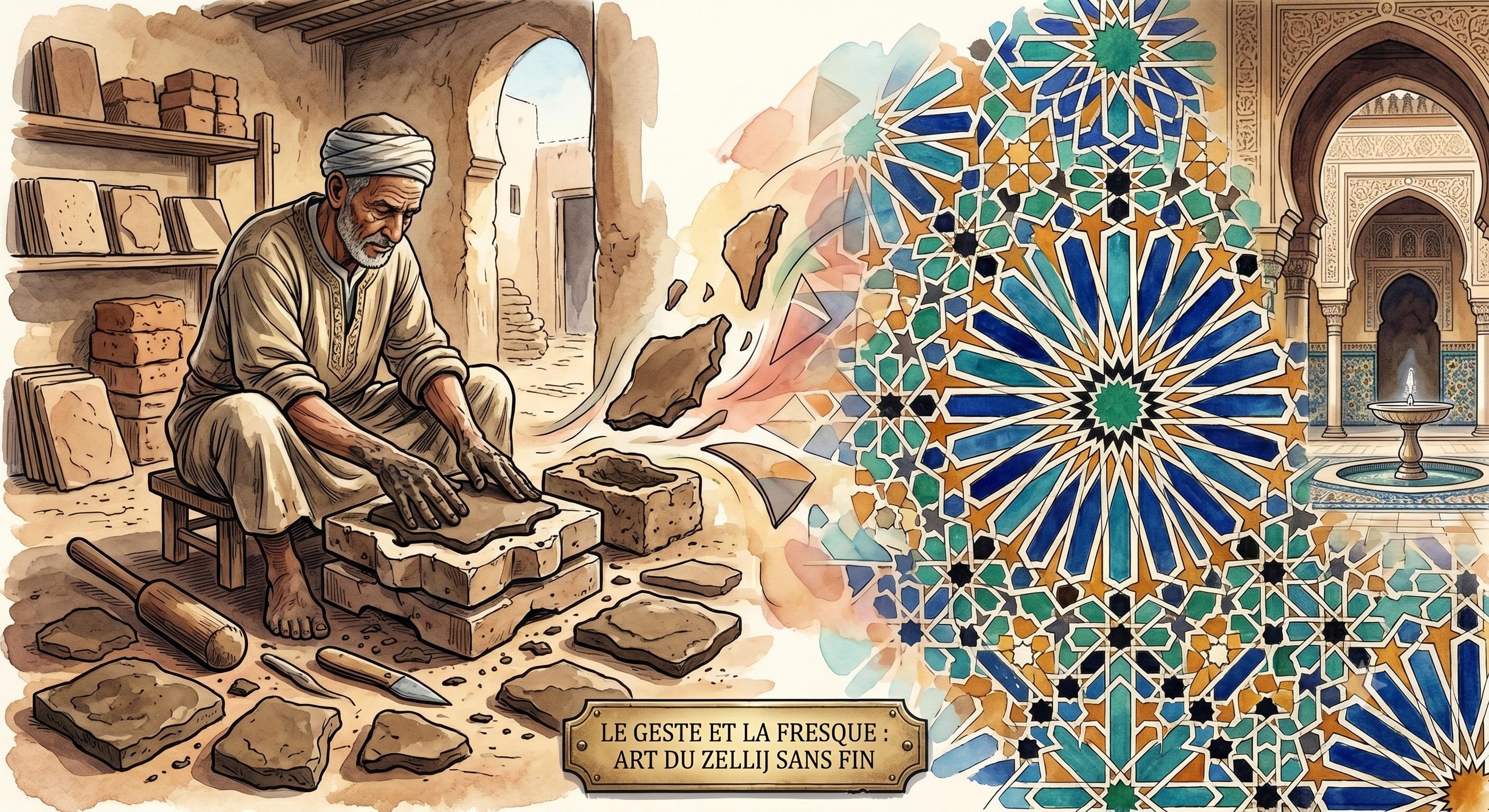
In the Moroccan medinas, the M3allem — literally "the one who knows" — is the master craftsman who holds knowledge acquired over decades of practice. He has been laying Zellij tiles for forty years. He knows how the hammer must sound against the faience for the cut to be clean. He knows which clay for which gibs depending on seasonal humidity. He knows how Marrakech leather responds to August heat.

This knowledge is not in a manual. It is not in a skills framework. It is in the hands, in the eyes, in the body of the M3allem — and it can only be transmitted one way: the Met3allem, the apprentice, sits beside the master. He watches. He imitates. He fails. He starts again. And one day — after months, sometimes years — the gesture becomes right. Not because it was explained. Because he watched and repeated until it was incorporated.

◆ WHY THESE INDUSTRIES SURVIVED

Morocco's ancestral arts survived 20th-century industrialisation, globalisation and mass tourism — not despite their refusal to modernise, but through the continuity of the M3allem/Met3allem process. When this chain broke in certain guilds — through rural exodus, forced industrialisation, absence of transmission — the art disappeared. Not the techniques in the books. The art. Because art is not in books. It is in the hands that learned it from other hands.

M3allem laying Zellij — from the craftsman to the finished work
The M3allem at work — from the laying hand to the completed masterpiece · Moroccan medina
◆ THE SAME MECHANISM — ANOTHER MEDINA

The server room is a medina. The cables are the alleyways. The racks are the workshops. The senior SRE who shows the junior how to listen to fan noise to detect a thermal anomaly before the alert sounds is a M3allem. He does not explain it. He does it. And the junior who watches, who asks questions, who repeats under supervision, becomes in turn a M3allem — capable of transmitting.

HUMAN
2
SECTION 2 · FROM ECRITEL TO WEBORAMA — A MET3ALLEM'S JOURNEY
WHAT THE SENIORS TRANSMITTED THAT THE COURSES DID NOT

When I joined Ecritel, I was not a beginner. I had the training, the diplomas, the foundations. But training had not taught me what the seniors in place transmitted in real production conditions. What I received from them appears in no skills framework. Yet it is what built the engineer I became.

◆ THE THREE TRANSMISSIONS — FROM ECRITEL TO WEBORAMA

Patience. A senior taught me not to act immediately on an incident. To observe first. To read what the system was saying before touching anything. This discipline — not panicking, not fixing too fast, understanding before intervening — cannot be taught in a classroom. It is transmitted through the example of a man who stays calm when everyone around wants to act. I watched him do it. I integrated the posture before understanding the reason.

Technologies. Not technologies as in courses — technologies as they actually behave in production. The edge cases, the undocumented behaviours, the things that work when they should not and vice versa. This knowledge accumulates over years of incidents. A senior who shares it condenses years of experience into a few hours of informal conversation around a fault.

Management capabilities. How to write a post-mortem that does not seek a culprit. How to announce a failure to a client without losing their trust. How to manage an on-call team without creating resentment. These competences are acquired by observing managers who exercise them — not by reading management books.

◆ NASSIHA — WHAT THIS TRANSMISSION REQUIRES

The M3allem/Met3allem transmission requires time, proximity and trust. It cannot be decreed by an HR policy. It requires the senior to have the availability to transmit — which presupposes a work environment structured not solely around immediate performance, but also around the continuity of knowledge.

HUMAN
3
SECTION 3 · WHAT THE MENTOR TRANSMITS THAT TRAINING CANNOT
TACIT KNOWLEDGE — THE INVISIBLE LAYER OF COMPETENCE

Training — whatever its quality — transmits explicit knowledge. What can be formalised, written, assessed. The Foundation of Iron transmits cabling, addressing, protocols, systems administration. A good course transmits the fundamentals of theory and supervised practice. What training cannot transmit is tacit knowledge — the invisible layer of competence that only real-condition practice, under a mentor's eye, can build.

◆ TACIT KNOWLEDGE IN INFRASTRUCTURE — WHAT IT IS CONCRETELY

Incident intuition: the senior who enters the server room and knows, before looking at metrics, that something is wrong — because the ambient sound has changed, because a switch LED is blinking in a particular way, because the room temperature is half a degree higher than usual. This intuition is acquired over thousands of hours of physical presence in server rooms.

Judgement under pressure: knowing when to act and when to wait. Knowing when to escalate and when to manage alone. Knowing when the quick fix will worsen the situation. This judgement is not taught — it is forged in real incidents, alongside someone who has already forged it.

Team culture: how one behaves in an SRE team. Where the boundary lies between help and dependence. What the difference is between productive silence during an incident and anxious silence. The right way to ask a senior a question without signalling you have not understood what you should have. These cultural codes are learned through immersion.

◆ WHY THE COURSE ALONE IS NOT ENOUGH — EVEN THE BEST

A driving lesson can be excellent — highway code theory, simulator exercises, explanation of reflexes to develop. It does not replace the 3,000 kilometres with an experienced instructor in real traffic conditions. Bare-metal infrastructure works exactly the same way. The Foundation of Iron is the highway code. The production server room with a senior is real traffic. Both are necessary. Neither alone is sufficient.

◆ NASSIHA — THE MENTOR IS NOT A TRAINER

The mentor does not follow a programme. They do not validate competences. They have no formalised pedagogical objectives. They do their job — and the Met3allem is there, alongside, watching and learning. This absence of formal structure is precisely what makes the transmission effective. The junior learns in real time what the senior actually does — not what a programme says they should do.
HUMAN
4
SECTION 4 · THE OBSERVATION DAY — THE MINIMAL FORMAT THAT CHANGES EVERYTHING
ONE DAY IN A SERVER ROOM IS WORTH MORE THAN A SEMESTER OF THEORY

The SRE/student mentorship does not need to be a six-month internship. It can start with one day. Or two. A day where the student is present as an observer — not as an intern, not as productive, not as assessable. As an observer. They watch. They are there. And this presence alone changes something irreversible in their mental representation of the profession.

◆ WHAT HAPPENS DURING AN OBSERVATION DAY

Morning: the student arrives at the premises. They see a technical open space — the screens, the open terminals, the working atmosphere. They attend a stand-up. They hear the tickets, the priorities, the vocabulary. Not to understand everything — to hear the register, the way engineers talk about systems, the casualness or tension depending on the signals of the moment.

The rack visit: the SRE takes them into the server room. They see the servers. They hear the fans. They feel the temperature difference between the hot and cold aisles. They touch a cable. They watch an LED blink. This physical moment — this sensory encounter with the infrastructure — is often the first trigger. The system stops being an abstraction. It becomes real.

The break: the student eats with the team. The informal conversations are the most valuable part of the day. Stories of incidents, anecdotes about memorable failures, debates about architecture choices, corridor jokes. They hear the team culture in natural mode. They understand how these people think about their profession when nobody is evaluating them.

The incident if luck allows: if an incident occurs during the day, the student observes the response in real time. This is the most formative possible sequence — watching how an experienced engineer moves from alert to diagnosis, from diagnosis to decision, from decision to resolution. Without being in the critical path. Just observing.

◆ WHAT THE STUDENT TAKES AWAY — THAT TRAINING WOULD NOT HAVE GIVEN

A concrete image of the profession that replaces abstract or romanticised representations. The certainty that this profession is accessible — that the engineers in front of them are normal people with learned methods, not born geniuses. A human connection with a professional who can answer their questions. And often — the vocational trigger that definitively confirms or rules out the professional direction.

HUMAN
5
SECTION 5 · THE MENTORSHIP SYSTEM — HOW TO BUILD IT
FROM INFORMAL M3ALLEM TO STRUCTURED MENTORSHIP

M3allem/Met3allem mentorship in infrastructure does not need to be a heavy programme. It needs to be intentional. The difference between the informal mentoring that already exists in teams and structured mentorship is the explicit decision to do it — and the minimal framework that makes it possible without overloading the mentor.

◆ THE ROLE OF HR — FACILITATOR, NOT MANAGER

HR is the bridge between the school or training organisation and the infrastructure team. Their role is not to manage the content of mentorship — they do not have the technical competence for that. Their role is to create the connection: identify SREs and engineers willing to mentor, contact BTS SIO programmes, DUT Networks, engineering schools and training organisations, and logistically organise the observation days. A simple agreement, a day blocked in the calendar, a visitor badge. The rest happens naturally.

◆ WHAT WE ASK OF THE SRE MENTOR — AND WHAT WE DO NOT

We ask: to do their work normally in the student's presence. To take them on a server room visit. To include them in the break. To be available to answer their questions at the end of the day. That is all.

We do not ask: to prepare a pedagogical programme. To validate competences. To fill in assessment forms. To adapt to a framework. To modify their working method. The power of the M3allem format is precisely that knowledge transmits in normal action, not in an artificial pedagogical parenthesis.

◆ THE NATURAL PROGRESSION — FROM THE DAY TO APPRENTICESHIP

One observation day can become two. Then a week of observation placement at the end of the BTS. Then a work-study programme. Then a first permanent contract in the team the student already knows — because they have seen the racks, eaten with the engineers, observed the team culture. Recruitment is no longer a gamble on a CV — it is the logical continuation of a built relationship. And integration is divided by ten because the Met3allem already knows their M3allem.

HUMAN
6
SECTION 6 · THE PROPOSAL — THE COMPLETE CHAIN
TRAINING · MENTOR · MENTORSHIP · EMPLOYMENT

This study completes the Opération Dindon corpus by adding the missing link between training and employment. The Foundation of Iron transmits the fundamentals. The BTS and DUT provide the academic framework. Arduino in middle school opens vocations. But between the best-designed training and the operational engineer, the M3allem is missing — the transmitter of tacit knowledge that only real production conditions can activate.

◆ THE IDEAL CHAIN — FROM 13 TO OPERATIONAL

Middle school (13-15): Arduino, robotics, connected car. Hands in the machine before theory. The vocational trigger.

Vocational high school / BTS / DUT (16-20): The Foundation of Iron in the frameworks. Fundamentals from physical layer to service layer. Basic technical competence.

Observation day (during BTS / DUT): One day in a real server room. The racks, the teams, the break, the incident if luck allows. The concrete that anchors training in reality.

Work-study or long placement (end of training): The Met3allem in real conditions, alongside a M3allem. Tacit knowledge transmission — patience, judgement, team culture.

First role (20-22): The engineer arrives operational on the physical layer, with an already-constituted human network, an already-integrated team culture, and a M3allem who can still answer the phone when something incomprehensible happens at 3am.

◆ WHAT COMPANIES GAIN BY INVESTING IN MENTORSHIP

A less risky hire — recruiting someone already known. Faster integration — the Met3allem knows the culture, the tools, the people. Stronger loyalty — you do not easily leave a team with which you have a transmission bond. And the perpetuation of tacit knowledge — today's Met3allem will become tomorrow's M3allem.

◆◆◆

The Zellij of Fès did not survive because there were books about Zellij. It survived because there were M3allems who accepted taking Met3allems beside them. Bare-metal infrastructure deserves the same honour.

◆◆◆
NEMO SUPRA LEGEM EST
← PreviousNext →