100%
GRIMOIRE
GrimoireDindon CorpusSynthesis VolumesThe Foundation of Iron
FRENAR
RATIO
STRUCTURAL STUDY · OPÉRATION DINDON · JUNE 2026
◆◆◆
THE FINOPS
OF THE LAST GRAM
Precious metal recovery
from end-of-life bare-metal hardware
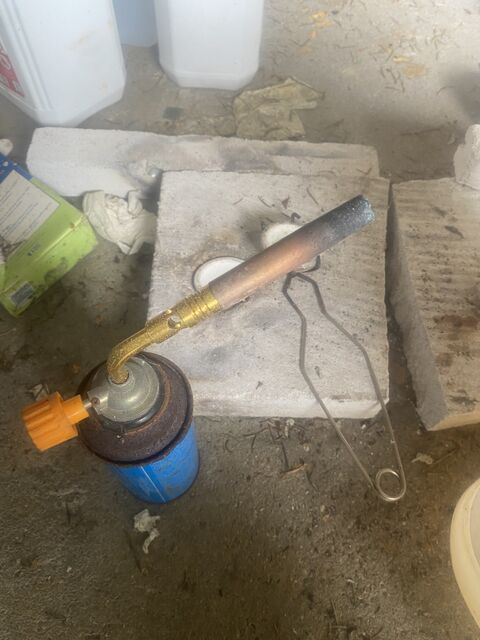
DIY Lab — torch and gold recovery crucible
DIY Lab Amine RAITI — From rack to crucible · SysAdmin Alchemy
◆ CONTEXT OF THE STUDY

After every rack/derack operation, end-of-life servers accumulate. The traditional WEEE recycling chain pays between €0 and €50 per server — or charges for collection. This study documents a radical alternative: direct recovery of precious metals contained in obsolete hardware. Gold, copper, silver, palladium — the residual value is real, measurable, and extractable with accessible lab equipment.

Amine RAITI — Infrastructure Architect & SRE
Former engineering school professor · Infrastructure instructor
Public document · CC BY-NC-SA 4.0 · AI Powered by Amine · Opération Dindon
RATIO
1
SECTION 1 · THE ECONOMIC THESIS — WHAT A SERVER IS REALLY WORTH
THE RESIDUAL VALUE NOBODY CALCULATES

A 5-year-old Dell R640 server is considered an end-of-life cost. It costs money to recycle, store, move. Nobody in IT calculates what it contains in gross metallurgical value. This calculation exists — and it changes the perspective.

◆ METAL CONTENT OF A STANDARD 1U SERVER

Gold (Au): 0.2 to 0.5g depending on model. Present in DIMM gold fingers, PCIe connectors, CPU socket contacts, high-end SAS/SATA connectors, chipset chips. June 2026 rate: ~€85/g. Value: €17 to €42 per server.

Copper (Cu): 0.5 to 1.5kg in cables, connectors, thick PCB traces. Rate: ~€9/kg. Value: €4 to €13 per server.

Silver (Ag): traces in some contacts and capacitors. 0.1 to 0.3g. Rate: ~€0.95/g. Value: €0.10 to €0.30 per server.

Palladium (Pd): present in MLCC capacitors on motherboards and high-end network cards. 0.01 to 0.05g. Rate: ~€35/g. Value: €0.35 to €1.75 per server.

Estimated total per R640 server: €22 to €58 in raw precious metals.
For a rack of 40 servers: €880 to €2,300 in recoverable residual value.

◆ COMPARISON WITH THE WEEE CHAIN

The licensed WEEE chain buys servers in bulk — between €0 and €50 per unit depending on condition. It sometimes charges for collection on batches under 500kg. It absorbs the metal value in its margins. Direct recovery bypasses this intermediation — at the cost of a time and lab equipment investment that this study documents and costs out.

RATIO
2
SECTION 2 · THE PROCESS — SYSADMIN ALCHEMY
FROM COMPONENT TO CRUCIBLE — TWO OPTIONS
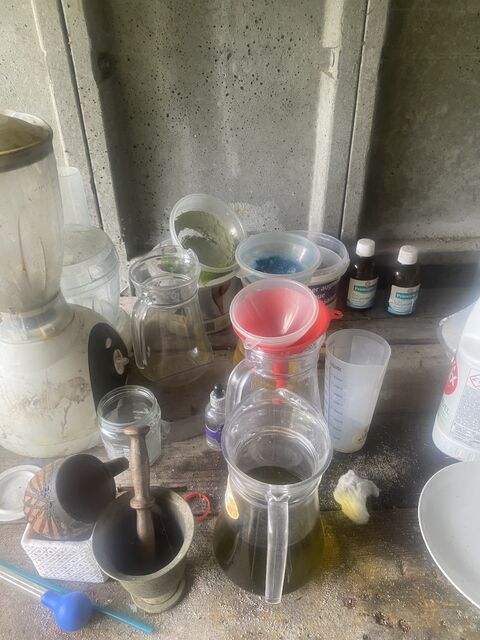
DIY Lab — chemical mixing
Chemical preparation · DIY Lab Amine RAITI
⚠️ MAJOR WARNING — NON-NEGOTIABLE SAFETY

Handling hazardous chemicals (strong acids, powerful oxidants). Mandatory PPE: acid-resistant gloves, full-seal goggles, minimum FFP3 mask. Ventilation essential: outdoors or chemical fume hood. Never alone. Keep sodium bicarbonate on hand to neutralise splashes. Know the Poison Control Centre number.

◆ OPTION A — PCBs AND CONNECTORS (ACID METHOD)

Copper dissolution: immerse connectors in a mixture of hydrochloric acid (HCl 33%) and hydrogen peroxide H₂O₂ (12%). Accessible version: concentrated white vinegar + sea salt + H₂O₂ (12%). Adding an aquarium air pump accelerates copper dissolution and detachment of gold foils — these float to the surface.

Purification: collect gold foils. Dissolve in 200ml HCl + 2 tbsp sodium nitrate (NaNO₃). Heat to 80°C for 15 minutes. Alternative: HCl + a few ml of bleach (⚠️ extremely dangerous — chlorine gas release).

Filtration and precipitation: filter the solution. Neutralise with sulfamic acid (except bleach method). Precipitate pure gold with iron(II) sulfate (FeSO₄). Rest 24h. Brown gold powder settles at the bottom.

Melting: collect the powder, dry it, melt with torch in graphite or refractory clay crucible.

◆ OPTION B — CHIPS AND COMPONENTS (INCINERATION + CHEMISTRY)

Pre-incineration: separate chips from PCBs. Burn outdoors (barbecue or fireplace) to eliminate epoxy resins and organic carbon. The ash contains concentrated metals.

Chemical treatment: the dissolution and precipitation process is identical to Option A. The yield is slightly lower but gold per gram of treated material is higher.

RATIO
3
SECTION 3 · NEUTRALISATION — THE STEP THAT CANNOT BE SKIPPED
CHEMICAL WASTE — MANDATORY PROTOCOL
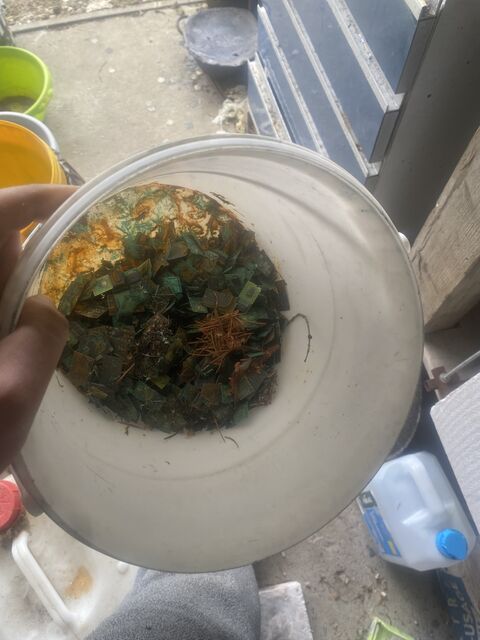
DIY Lab — chemical waste management after extraction
Chemical waste management after extraction · DIY Lab Amine RAITI
⚠️ CRITICAL POINT — NEVER DISCARD SPENT SOLUTIONS AS-IS

Post-extraction solutions contain strong acids and dissolved metals — copper, iron, tin, lead. Pouring them down the drain or into nature is an environmental offence. It is also a beginner's mistake. The neutralisation protocol is as important as the extraction protocol.

◆ CAUSTIC SODA NEUTRALISATION — STEP BY STEP

Materials: caustic soda (sodium hydroxide NaOH, granules or solution), pH paper or pH meter, HDPE plastic container, stirrer.

Protocol:
1. Slowly pour caustic soda into the spent acid solution (never the reverse — risk of violent splashing). The reaction is exothermic — the mixture heats up.
2. Observe the pH rising. Dissolved metals progressively precipitate as coloured sludge — blue-green for copper, rust-brown for iron, grey for tin.
3. Continue until neutral pH (7). Check with pH paper or meter.
4. Leave to settle 24 to 48 hours. Sludge settles at the bottom.
5. Filter the solid sludge. Package in sealed bags labelled "metallic waste — specialist treatment".
6. Drop sludge at a specialist hazardous waste facility (licensed WEEE processor).
7. The neutralised liquid at ~pH 7 can be disposed of in the drainage system — check local regulations.

The copper in the sludge can itself be sold to specialist smelters (Aurubis, Comet Traitements) if volumes are sufficient.

◆ SLUDGE AS A SECOND VALUE SOURCE

Neutralisation sludge from treating 40 servers contains 50 to 200g of precipitated copper, plus traces of nickel and tin. Some recovery smelters (Comet Traitements in Belgium, Umicore) buy this sludge at variable rates by concentration. It is not a fortune — but it is an additional value stream on waste that would otherwise cost money to eliminate.

RATIO
4
SECTION 4 · THE PROFITABILITY CALCULATION
THE DIY LAB ROI
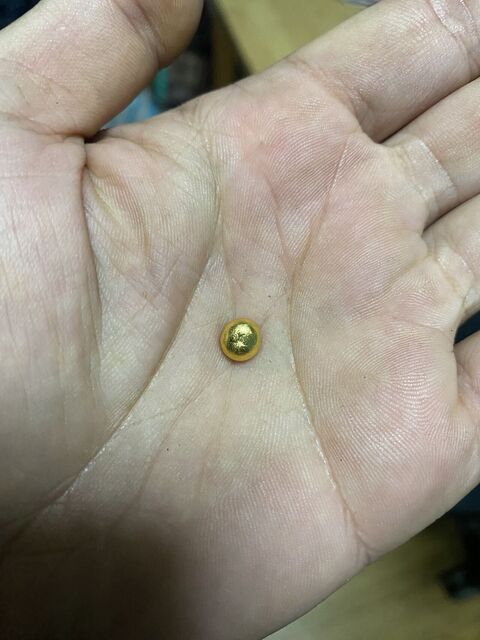
DIY Lab — melting crucible with recovered gold
The crucible after melting — recovered gold · DIY Lab Amine RAITI
◆ INITIAL INVESTMENT — THE DIY LAB

Safety equipment: acid gloves (€15), full-seal goggles (€25), FFP3 masks x5 (€15), chemical apron (€20). Total: ~€75
Lab equipment: aquarium air pump (€12), HDPE 5L containers x3 (€25), filter funnel + filter paper (€10), pH meter (€15), butane torch + refill (€35), graphite crucible (€20). Total: ~€120
Reagents (for 40 servers): HCl 33% 2L (€8), H₂O₂ 12% 2L (€6), NaNO₃ 500g (€12), FeSO₄ 500g (€8), sulfamic acid 500g (€10), NaOH granules 1kg (€6). Total: ~€50
Total first-batch investment: €245 (reusable for subsequent batches)

◆ PROFITABILITY TABLE — BATCH OF 40 R640 SERVERS

Gross recoverable value: €880 to €2,300 (gold + copper + silver)
Reagent cost batch 1: €50
Equipment cost (amortised over 5 batches): €50/batch
Estimated processing time: 2 days (preparation + chemistry + neutralisation)
WEEE disposal cost avoided: €0 to €500 depending on provider
Net recovered batch 1: €780 to €2,200 — i.e. €19 to €55 per server

From batch 2: equipment is amortised. Marginal cost drops to €50 of reagents. Net recovered rises to €830 to €2,250.

◆ WHAT THE CALCULATION DOES NOT ACCOUNT FOR

The SysAdmin's time — 2 days of processing represents a salary cost. This process is relevant for an enthusiast who finds the process interesting in itself, or for an organisation processing sufficient volumes to justify the time investment. It is not a full-time business — it is opportunistic FinOps on hardware that would otherwise be a pure cost.

RATIO
5
SECTION 5 · REGULATION — WHAT IS LEGALLY PERMITTED
LEGAL FRAMEWORK IN FRANCE

Recovering precious metals from IT hardware is legal in France in a private or professional context, subject to hazardous waste regulations. Three key points to know before starting.

◆ POINT 1 — EMPLOYER AGREEMENT FOR COMPANY EQUIPMENT

IT equipment belongs to the company until formally written off. Recovering servers off-inventory without written agreement creates legal risk. The correct approach: obtain a written free transfer deed or a signed decommissioning report from management or the procurement department. This document formalises the transfer of ownership and legally covers the recovery.

◆ POINT 2 — CHEMICAL WASTE PRODUCED

Acid solutions and metal sludge produced are classified as hazardous waste under European directive 2008/98/EC. For personal or lab use, volumes generally remain below mandatory declaration thresholds (10 litres of hazardous liquid waste per month for individuals). Above these thresholds, a declaration to the installations classées inspectorate (ICPE) may be required. Depositing sludge at a licensed specialist waste facility is always required — it is both a legal obligation and the right thing to do.

◆ POINT 3 — SELLING RECOVERED GOLD

Selling recovered gold is legal in France. Gold buyers (jewellers, buying counters, specialist smelters) buy industrial recovery gold. For quantities under a few grams, the transaction is informal. Above €500 in value per transaction, the buyer must verify the seller's identity. Keeping traceability of the source material (transfer deed) is good practice even below this threshold.

◆ NASSIHA — THIS PROCESS IS NOT DESIGNED FOR INDUSTRIAL SCALE

This process is documented for a SysAdmin enthusiast treating hardware from their own rack or their company's with agreement. For industrial volumes (tonnes of PCBs), licensed operators like Umicore, Aurubis or Comet Traitements have the infrastructure and authorisations — and far superior extraction yields. This study documents the DIY level — lab, torch, crucible, aquarium air pump.

RATIO
6
SECTION 6 · THE PEDAGOGICAL THESIS — THE FOUNDATION OF IRON THROUGH CHEMISTRY
THE ENGINEER WHO MELTED THEIR GOLD UNDERSTANDS WHAT IS IN A SERVER

This process is more than a radical FinOps exercise. It is a lesson in applied chemistry, materials physics, and circular economy that the infrastructure engineer learns by doing. It completes the Foundation of Iron with a dimension that lectures cannot provide: the physical and chemical value of what they administer.

◆ WHAT THIS PROCESS TEACHES THAT A COURSE CANNOT

The engineer who has done this process once viscerally understands why PCIe connectors are gold and not copper — oxidation resistance, conductivity, ductility. They understand why DIMMs have "gold fingers" — perfect electrical contact over millions of insertion cycles. They know their Dell server contains gold in the same way an ingot does — differently concentrated, differently distributed, but real and measurable. This material knowledge is exactly what cloud training abstracts away and what the Foundation of Iron seeks to rebuild.

◆ THE LINK WITH "THE DIGITAL IRON"

"The Digital Iron" documented that the chip is the ingot of the 21st century — a rare, strategic, geopolitically sensitive resource. This process is the experimental demonstration of this thesis: the server the administrator installs literally contains precious metals, exactly as ore contains gold. The chain TSMC → chip → server → recovered gold is a real value chain that the DIY lab makes visible, tangible, measurable.

◆ FOR TRAINING AND CURRICULA

This process is a possible pedagogical format in BTS or DUT infrastructure curricula — a supervised practical lab day around dismantling, identifying high-value metal components, and supervised recovery. This is not a chemistry lesson — it is an infrastructure lesson that goes through chemistry to physically anchor the value of hardware. The student who has seen gold emerge from a PCIe connector understands its value differently from one who only read about it in a textbook.

◆◆◆

The FinOps of the last gram is not avarice. It is respect — for the physical value of what one administers, for the rare resources that have served, and for the engineer who knows what is in their rack down to the last atom.

◆◆◆
NEMO SUPRA LEGEM EST

Place images in the same folder: lab_chalumeau.jpg · lab_melange.jpg · lab_dechets.jpg · lab_creuset.jpg