100%
GRIMOIRE
GrimoireDindon CorpusSynthesis VolumesThe Foundation of Iron
FRENAR
HUMAN
STRUCTURAL STUDY · OPÉRATION DINDON · JUNE 2026
◆◆◆
THE YEMENI
DINNER
What an evening at €78 per person does
that a €2,000 offsite cannot
◆ CONTEXT OF THE STUDY

This study steps outside the technical perimeter of the Opération Dindon corpus to address a direct management angle: team cohesion in infrastructure. It starts from an observation as Head of SRE — that real team cohesion is not built in corporate offsite events, but in carefully chosen human moments. It illustrates this thesis with a concrete, costed, reproducible evening programme.

◆◆◆
Amine RAITI — Infrastructure Architect & SRE
Former engineering school professor · Infrastructure instructor
Public document · CC BY-NC-SA 4.0 · AI Powered by Amine · Opération Dindon
HUMAN
1
SECTION 1 · THE PROGRAMME
AN EVENING FOR 5 — CHAMPS-ÉLYSÉES, CHÂTELET

The programme that follows is not a theoretical proposal. It is a programme that was executed, with an SRE team of 5 people. It is reproduced here as-is — with the timings, the locations, the total cost — because the precision of the concrete is more useful than the generality of a principle.

◆ THE EVENING PROGRAMME

18:00 — Leave the office together. No individual cars or metro journeys. The group leaves as a group.

18:45 — Bowling session. Walked from the office to the bowling alley — approximately 45 minutes on foot through Paris. The walk is not a commute: it is the first activity of the evening.

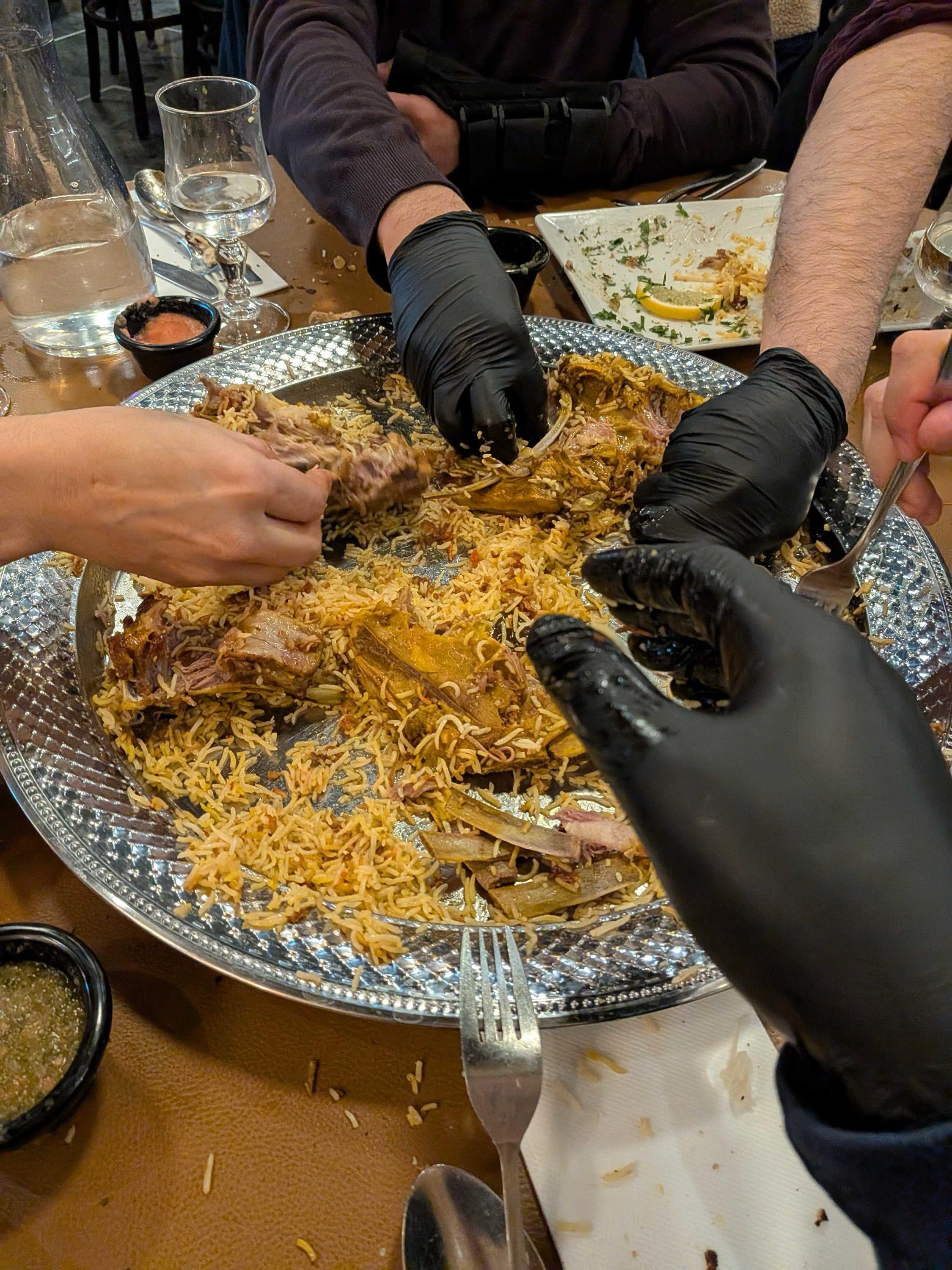
20:30 — Gastronomic dinner at a Yemeni restaurant on the Champs-Élysées. A deliberate choice — not a standard brasserie, not the usual company restaurant. A place that surprises, that has something to say, that opens a conversation beyond work.

21:00 — Move to Châtelet for a drink. A final informal moment, standing, before parting.

22:00 — Everyone goes home. Happy. Clear-headed.

Total cost: €390 all-inclusive for 5 people, author's hotel night included.
Cost per person: €78.

The team eating together by hand from the same dish — Yemeni restaurant, Champs-Élysées
The shared dish — the team eating together by hand from the same plate, as in Morocco · © Amine RAITI
◆ NASSIHA — WHAT IS NOT IN THE BUDGET

€390 is the direct cost. What is not in that figure: no team-building consultant, no seminar room, no conference badge, no out-of-Paris travel costs, no difficult morning after. The true cost of a two-day corporate offsite for 5 people — travel, hotel, facilitator, room, meals — regularly exceeds €10,000. The ROI of the evening, measured in cohesion quality produced per euro spent, is not comparable.

HUMAN
2
SECTION 2 · WHY IT WORKS
THREE MECHANISMS THAT THE OFFSITE CANNOT REPLICATE

The evening is not effective despite its modest cost. It is effective partly because of it — because the absence of corporate overproduction leaves room for the real human mechanisms of connection. Three of them are at work in this programme.

◆ MECHANISM 1 — WALKING REMOVES HIERARCHY

45 minutes on foot through Paris, as a group, before any activity. This is not a commute — it is the first conversation of the evening. People talk differently when walking side by side than when sitting face to face in a meeting room. Walking removes the desk, the badge, the org chart. It puts everyone at the same pace, literally. The Head of SRE and the junior walk in step. The hierarchy does not disappear — it goes into standby for the evening.

◆ MECHANISM 2 — THE GAME REVEALS AND LIBERATES

Bowling creates a light competition, without professional stakes, in which anyone can shine or fail without consequence. The most reserved engineer in meetings might be the best player. The manager might throw a gutter ball to the laughter of the whole team. These momentary role reversals are valuable: they reveal personality facets that the professional context masks, and they create shared memories — "remember when you got a strike on the last throw" — that weave the fabric of the group over time.

◆ MECHANISM 3 — THE CHOICE OF VENUE SAYS SOMETHING ABOUT THE MANAGER

A Yemeni restaurant on the Champs-Élysées is not a neutral choice. It is not the brasserie next door, not the usual company restaurant. It is a choice that says: I am taking you somewhere you may not know, a cuisine you may never have tasted, a place that tells a story. This choice positions the manager as someone curious, open, off the beaten track — and this image reflects onto the team, which recognises itself in its manager.

HUMAN
3
SECTION 3 · THE 22:00 CLOSE
THE DETAIL THAT CHANGES EVERYTHING

There is one element of the programme that most team-building events ignore, and it makes all the difference: the evening ends at 22:00. Everyone goes home happy, clear-headed. This is not a logistical constraint — it is a deliberate management decision.

◆ WHY 22:00 AND NOT MIDNIGHT

An evening that extends beyond a certain threshold produces risks the manager must anticipate: the fatigue that turns good humour into irritability, the alcohol that lifts inhibitions in the wrong direction, the subgroups that form and exclude, the words that exceed the thought and are remembered the following morning. "Ending on a good note" is not a cliché — it is a technique. People remember how an evening ends, not just how it begins.

◆ "HAPPY AND CLEAR-HEADED" — WHAT THIS MEANS FOR THE TEAM

The following morning, everyone arrives at the office with the same shared memory — a good evening, no incident, no regrets. This shared memory is a trust capital the team can spend in the weeks that follow: to approach a difficult topic with less rigidity, to trust a colleague on a point they might previously have challenged, to get through a 3am production incident with the certainty that they will come out the other side together.

◆ COHESION IS NOT A STATE — IT IS A REGULAR INVESTMENT

A single evening does not create team cohesion. It maintains it, reinforces it, releases the accumulated friction. Cohesion is like infrastructure: it degrades if not maintained. One dinner per quarter — €78 per person, 4 times a year — represents €312 of annual investment per person in team cohesion. A production incident poorly managed because two team members only half-trust each other costs far more than that in extended MTTR, suboptimal decisions, and unnecessary escalations.

◆ NASSIHA — THE MANAGER WHO STAYS IN A HOTEL

The programme notes a hotel night for the author — included in the €390. This detail says something important: the manager lives far enough away to need a hotel, but organises the evening in Paris for their team anyway. This is not heroic sacrifice — it is a clearly stated priority. The team sees it. They remember it.
HUMAN
4
SECTION 4 · WHAT THE OFFSITE DOES NOT DO
THE PROBLEM WITH FORCED COHESION

The corporate team-building offsite is the instinctive reflex of organisations that want to improve cohesion. Two days in a hotel with a consultant, trust exercises, structured group activities, a presentation on personality styles. This format exists because it is billable, schedulable, and produces a report. Not because it is effective.

◆ FORCED COHESION PRODUCES ITS OPPOSITE

Putting 10 people in a seminar room for two days with the declared objective of "strengthening team cohesion" creates a social pressure that inhibits precisely what it seeks to produce. People know they are supposed to bond. This awareness produces a performance of bonding rather than genuine bonding. They play along with the exercises. They participate in the workshops. They go home two days later with offsite memories, not team memories.

◆ THE TIMESCALE PROBLEM

An annual two-day offsite represents 16 hours of "cohesion time" across 365 working days. That is 0.4% of working time dedicated to relationships between team members. The remaining 99.6% unfolds in meetings, incidents, tickets, and deadlines. Cohesion built over 16 intensive hours once a year is no more durable than cohesion maintained over 4 hours per quarter in a carefully chosen informal setting.

◆ WHAT ACTUALLY CREATES CONNECTION

Social psychology research on group cohesion converges on a few necessary conditions: sharing a common emotional experience, mutual discovery outside usual roles, and the feeling of having been chosen rather than summoned. The evening — walking, bowling, Yemeni dinner, drink at Châtelet — ticks all three. The offsite with its pre-formatted agenda and imposed participant list generally ticks none of them.

HUMAN
5
SECTION 5 · COHESION IN SRE TEAMS
WHY IT IS MORE CRITICAL IN INFRASTRUCTURE

Team cohesion matters in all professional contexts. It is critical in infrastructure. The reason is simple: SRE teams make decisions under maximum stress — at 3am, with a production system going down, with users or clients waiting, with limited time to diagnose and act. In these conditions, the quality of the relationship between team members is not a comfort — it is an operational variable.

◆ TRUST UNDER INCIDENT

During a major incident, two trust dynamics are critical. Technical trust — "I know my colleague knows what they are doing" — and relational trust — "I know my colleague will be honest about what they do not know". The second is harder to build than the first, and it is built precisely in moments outside work. An engineer who has seen their manager throw a gutter ball and laugh about it knows that manager can acknowledge their limits. This link between the informal and the professional is real and documented.

◆ THE INTERNAL CONFLICTS THAT DISAPPEAR

Tensions in an infrastructure team accumulate in the daily routine — poorly handed-off tickets, contested architecture decisions, unevenly distributed on-call, meetings that overrun. These frictions are normal. They become toxic when they have no outlet. The evening is the outlet. Not because it erases the problems — but because it puts the people first and the problems second. You do not resolve conflicts over a Yemeni dinner. You remember that the people you work with are people, not nodes in an org chart.

◆ NASSIHA — COHESION DOES NOT REPLACE MANAGEMENT

A team that goes out together once a quarter but whose structural problems are not addressed — excessive on-call load, absent recognition, unclear direction — will not be saved by bowling. Cohesion is a multiplier: it amplifies what is already in place, for better or worse. A good team with cohesion is excellent. A dysfunctional team with cohesion is more loyal in its dysfunction. The evening does not replace management — it complements it.

HUMAN
6
SECTION 6 · THE PROPOSAL
THE QUARTERLY DINNER PROTOCOL

The proposal of this study is concrete and reproducible. It requires no exceptional budget, no complex HR approval, no consultant. It requires a manager who decides that their team's cohesion is an operational priority and allocates 4 evenings per year to maintain it.

◆ THE FORMAT PRINCIPLES

Frequency: once per quarter. Often enough to maintain the bond, rare enough that the evening remains an anticipated event.

Size: ideally 4 to 7 people. Below that, the group effect does not occur. Above it, subgroups form naturally and the team does not experience the evening as a unit.

Three-part structure: a physical or playful activity (bowling, karting, escape room, walk) — a dinner in a thoughtfully chosen, non-formatted venue — a short informal moment before parting (a standing drink, not a second restaurant table).

Fixed closing time: 22:00 or 23:00 maximum. Define the end time before you start. End on a good note.

Target budget: €60 to €100 per person depending on the city. Less than that, you cut corners on the experience. More than that, you create a reciprocity obligation that weighs on those with financial constraints.

The venue choice is a statement: choose a restaurant that says something — a discovered cuisine, an unexpected neighbourhood, a place the manager loves and wants to share. Not the first TripAdvisor result.

◆ WHAT €312 PER PERSON PER YEAR BUYS

Four evenings at €78, that is €312 per person per year. For this budget, a manager buys: four 4-hour evenings where their team remembers it is a team. Production incidents handled with more fluidity because the trust exists before the crisis. Conflicts that dissolve because people see each other as people rather than roles. And reduced turnover — because you do not easily leave a team you have shared memories with.

◆◆◆

For not much money, you can maintain seamless team cohesion — the kind where internal conflicts disappear over a good dinner. The Yemeni restaurant on the Champs-Élysées proves it at €78 per person.

◆◆◆
NEMO SUPRA LEGEM EST